
Preparing for the IELTS can sometimes feel like juggling too many things at once—vocabulary lists, grammar rules, practice tests, essay structures, and speaking topics. It’s easy to feel like you’re drowning in notes and unsure where to begin.
Here’s the good news: there’s a simple yet powerful technique that can bring clarity to your preparation—mind mapping.
Mind mapping isn’t just for creative thinkers or artists; it’s a practical study tool that makes learning easier and more engaging. At Kinngsway Overseas Education, we’ve watched students transform their IELTS prep journey by using mind maps. They start feeling less stressed, more organized, and most importantly—more confident on exam day.
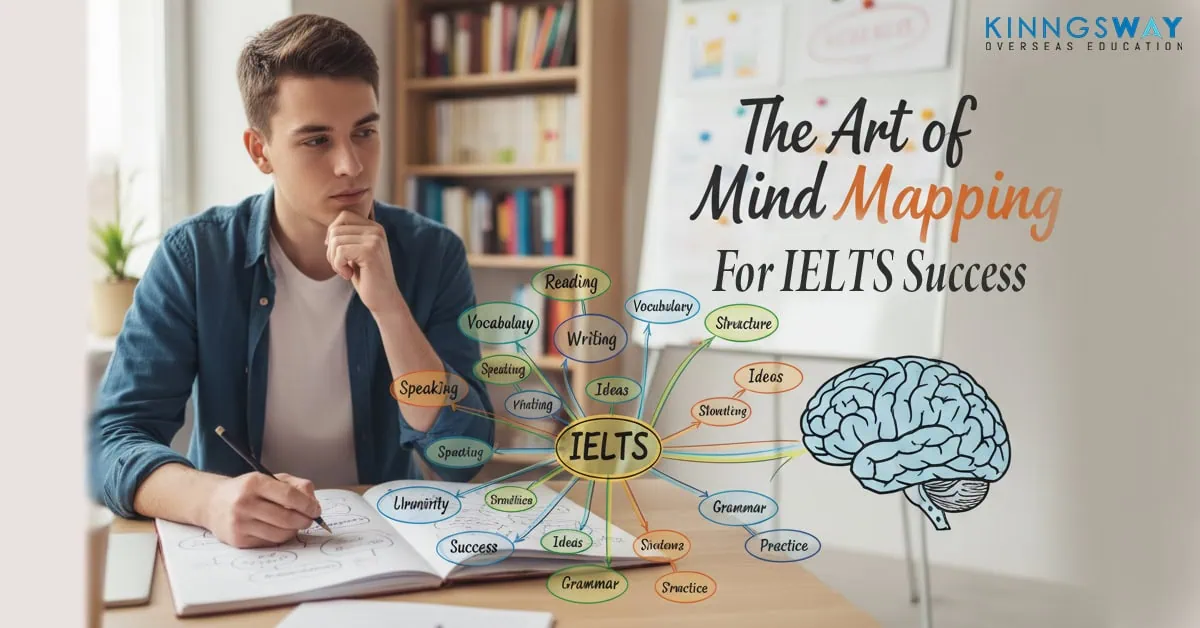
So, what exactly is mind mapping?
Think of a mind map like a tree.
- The trunk is your main idea—for example, IELTS Writing Task 2.
- The branches are the sub-topics—like introduction, body paragraphs, and conclusion.
- The leaves are the examples, phrases, and key vocabulary you’ll use.
Instead of long, messy notes, everything you need sits neatly on one page. You can see the big picture, while also remembering the small details.
Why does it work so well for IELTS?
Every IELTS Institute teaches strategies, but not all strategies click with students. Mind mapping works because:
- It helps you remember things faster – visuals and keywords stick in your brain.
- It makes you more creative – perfect for brainstorming essay and speaking ideas.
- It saves time – one mind map can summarize a whole lesson.
- It keeps your thoughts organized and clear – exactly what IELTS examiners look for.
- And honestly, it makes studying feel less boring and more fun.
Using Mind Maps in Each IELTS Module
Let’s break it down, section by section, so you can see how to use mind maps in your daily prep.
1. IELTS Listening
During the Listening test, you don’t have time to write full sentences. A mind map helps you quickly jot down keywords and see connections.
Example: If the audio is about “Renewable Energy”, your centre point is “Energy Sources”. Branches could be Solar, Wind, Hydro, each with mini-branches for their advantages or disadvantages.
This way, you don’t panic about missing details—you already have the structure in front of you.
2. IELTS Reading
Long passages can feel heavy, but mind maps break them down. You can:
- Write down the main idea of each paragraph.
- Note examples or evidence on side branches.
- Separate the author’s opinion from supporting facts.
When you face “matching headings” or “True/False/Not Given” questions, your mind map acts like a quick reference guide.
3. IELTS Writing
This is where mind mapping truly shines. Most students know the struggle—staring at a blank page, unsure how to start an essay.
With a mind map, planning becomes simple:
- Main idea in the middle (e.g., Technology in Education).
- Branch 1: Positive impacts (online learning, resources).
- Branch 2: Negative impacts (distractions, inequality).
- Branch 3: Real examples (Khan Academy, rural schools).
- Branch 4: Balanced conclusion.
In just two minutes, you have a full essay structure. No more wasting time thinking “what do I write next?”
4. IELTS Speaking
Ever gone blank during Part 2 of the Speaking test? That’s where mind maps save you.
Let’s say the cue card is: “Describe a Book You Recently Read”.
- Centre: Book title.
- Branches: Author, theme, why you liked it, impact on you.
By practicing this way, your answers flow naturally and you sound more confident—something examiners always notice.
How to Create an Effective Mind Map
You don’t need fancy tools to get started. A pen, paper, and a few colors are enough.
Here’s a quick step-by-step:
- Write the main topic in the centre.
- Add branches for subtopics.
- Use keywords only (not full sentences).
- Highlight or color-code important parts.
- Practice recalling the map from memory.
Tip: Many of our students also use free apps like XMind or MindMeister for digital mind maps.
Practical Student Tips
- Start small: Try creating one mind map for a single essay or speaking topic.
- Be personal: Use examples that relate to your life—it’ll be easier to remember.
- Share and discuss: At our IELTS coaching centre in Jammu, students often compare mind maps and learn new perspectives from each other.
- Review regularly: The more you redraw or revisit your maps, the stronger your memory gets.
The Confidence Factor
The biggest benefit of mind mapping isn’t just better notes—it’s the confidence you feel in the exam. Instead of panicking, your brain recalls the colourful, structured map you practiced with.
At our IELTS Institute in Jammu, many students have told us that this technique was a game-changer. It didn’t just help them get their desired band score—it also made studying less stressful and more enjoyable.
Final Thoughts – How Kinngsway Overseas Education Can Help
Success in IELTS isn’t about cramming; it’s about studying smart. Mind mapping is one of the smartest, simplest tools you can use.
At Kinngsway Overseas Education, we don’t just give you practice papers. We equip you with techniques like mind mapping, personalized coaching, and focused feedback so that you’re fully prepared to perform your best on exam day.
If you’re searching for the best IELTS coaching in Jammu, look no further. Join our IELTS coaching centre in Jammu and let us help you map your way—literally and figuratively—to IELTS success.